TS/P, TS/E, TS/W
Hydraulic Flame Arresters deflagration proof, detonation proof and short-time burning proof
Features
Productos agresivos, pegajosos o polimerizantes
Especialmente adecuado para sustancias agresivas, pegajosas o que polimerizan
Caudalímetro
Debe instalarse un caudalímetro volumétrico
Sensores de temperatura
Los sensores de temperatura en la zona de gas activan funciones de emergencia a temperaturas críticas para evitar la combustión de mezclas en la superficie líquida
Function and Description
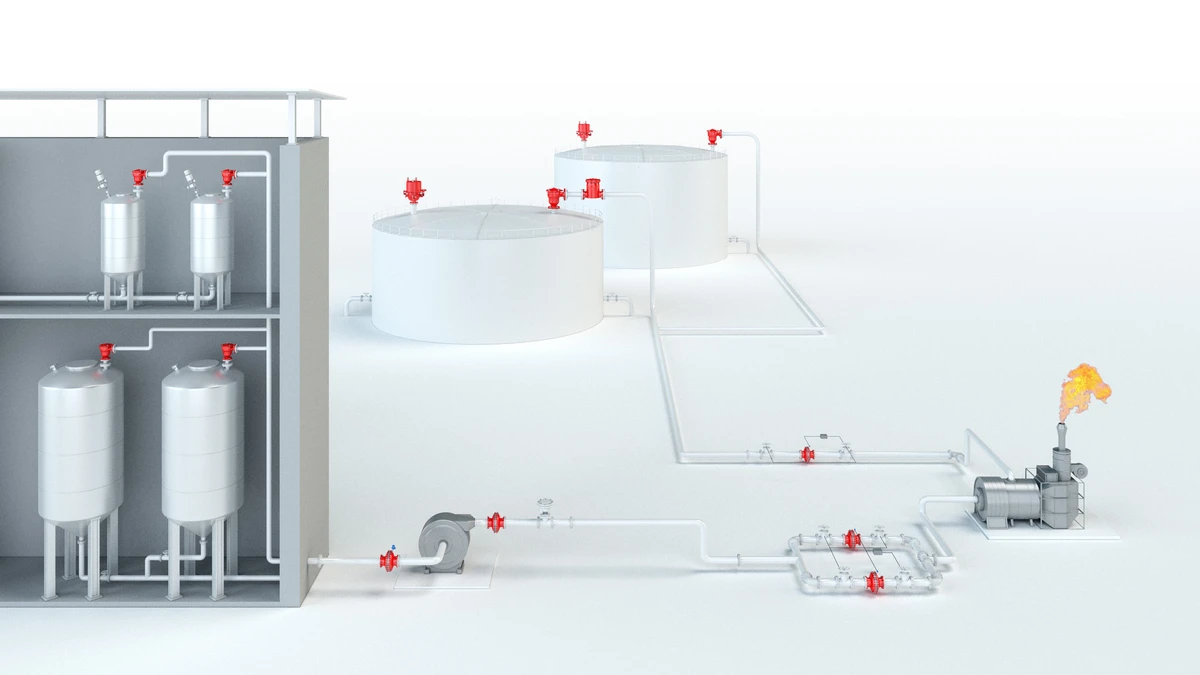
Protection of Explosion-Prone Process Plants
The
Pressure/vacuum relief valve
Pressure/vacuum relief valve is an umbrella term that includes pressure or vacuum relief valve as well as pressure and vacuum relief valve.
PROTEGO® type TS/… Series of Hydraulic
Flame Arresters
Flame arrester
Device fitted to the opening of an enclosure, or to the connecting pipe work of a system of enclosures, and whose intended function is to allow flow but prevent the transmission of a flame.
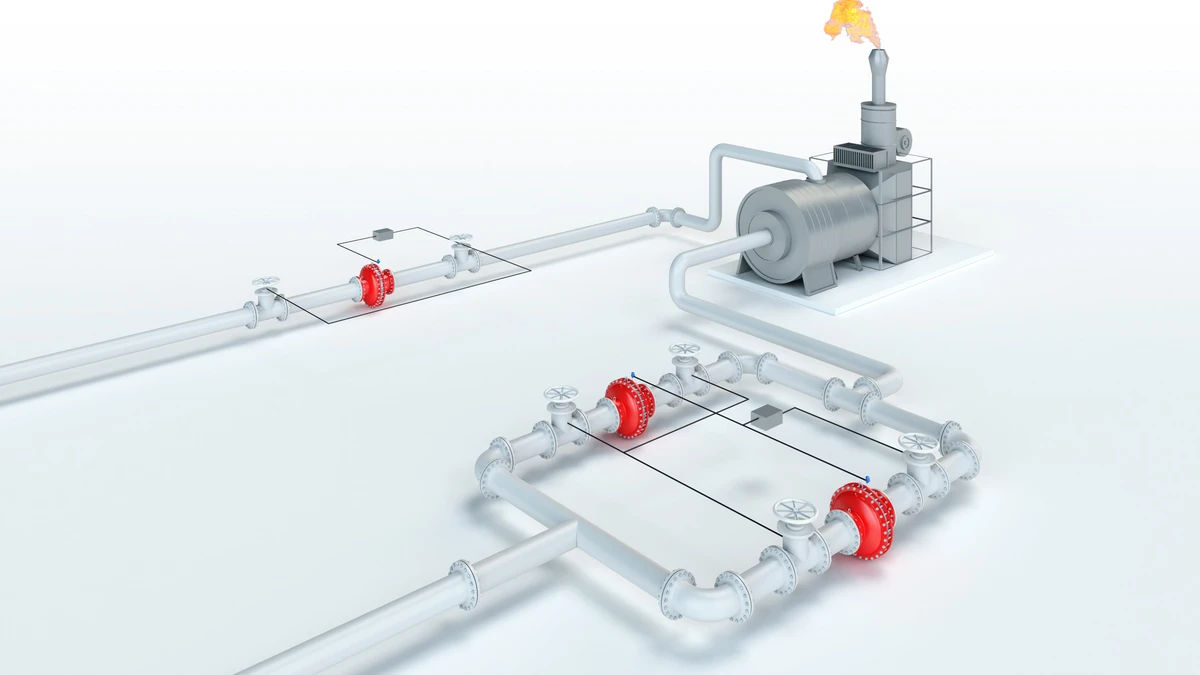
are mainly designed to protect process plants which are connected to waste thermal combustion units. Hydraulic Flame Arresters of the TS/… series are particularly suitable to protect plants which supply heavily contaminated, sticking, polymerizing or even foaming substances into thermal combustion units. Generally, it is necessary to protect the plant against in-line
deflagration
Deflagration
Explosion propagating at subsonic velocity (EN 1127-1:1997).
,
stable detonation
Stable detonation
A detonation is stable when it progresses through a confined system without significant variation of velocity and pressure characteristics.
, and
endurance burning
Endurance burning
Stabilized burning for an unlimited time.
hazards, and consider the plant‘s operating conditions.

Many Individual Certifications
The PROTEGO® TS/… Series of Hydraulic Flame Arresters guarantees flame transmission protection during short-time burning, deflagration, and stable detonation of gas/air mixtures or
product
Product
Includes equipment, protective systems, devices, components and combinations of these.
vapor/air mixtures of the relevant
explosion
Explosion
Abrupt oxidation or decomposition reaction producing an increase in temperature, pressure, or in both simultaneously.
groups in all ranges of flammable concentrations with a service temperature of up to +60 °C / 140 °F and an
operating pressure
Operating pressure
Operating pressure is the pressure existing at normal operating conditions within the system being protected.
up to 1.1 bar / 15 psi (absolute).
Flame Arresters
Flame Arresters
A flame arrester, deflagration arrester, or flame trap is a device or form of construction that will allow free passage of a gas or gaseous mixture but will interrupt or prevent the passage of flame.
of type TS/… are the only Hydraulic Flame Arresters which have been tested and certified for substances of all explosion groups. EU conformity according to the currently valid ATEX directive. Approvals according to other national/international regulations on request.
Main Component - Immersion Tank
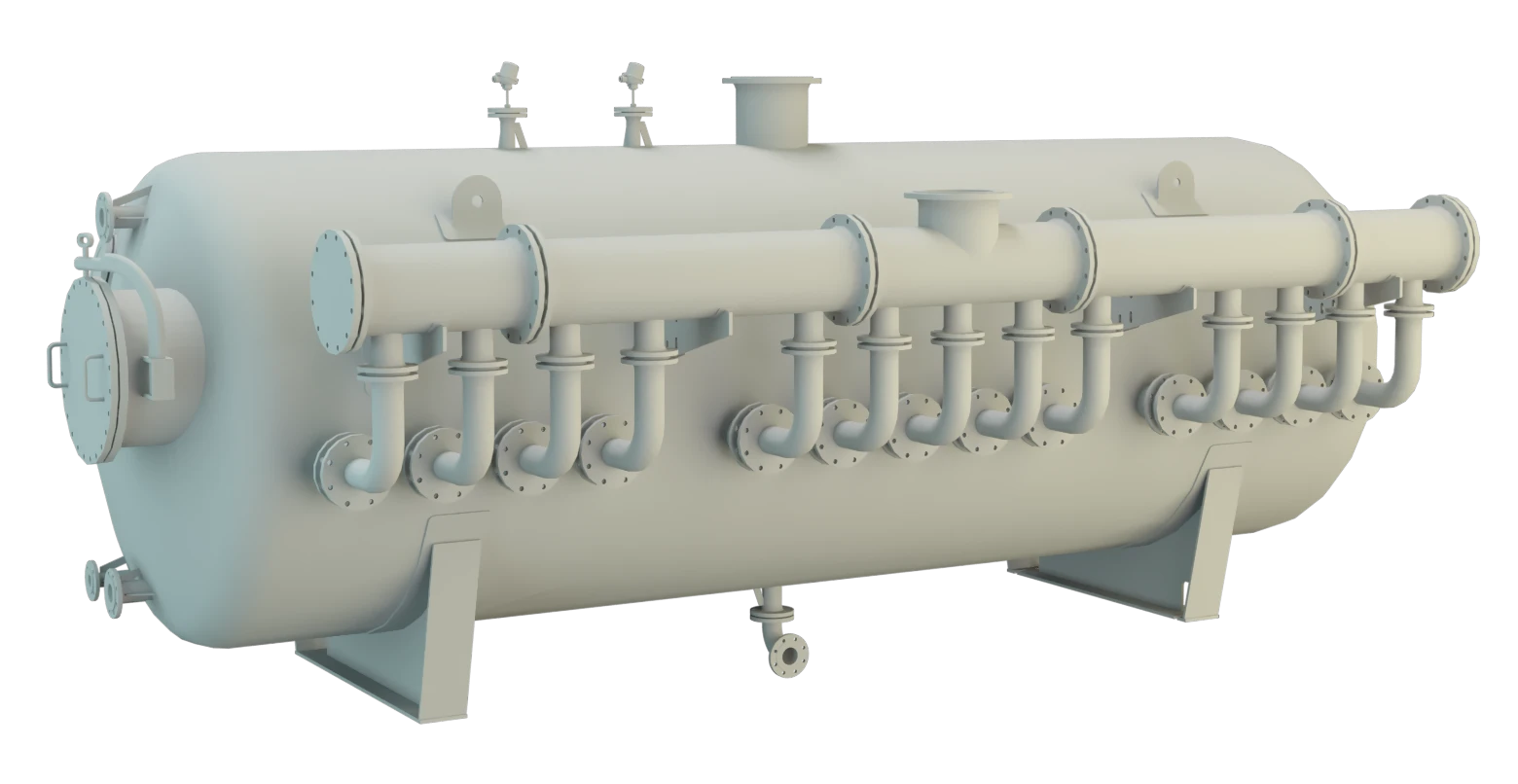
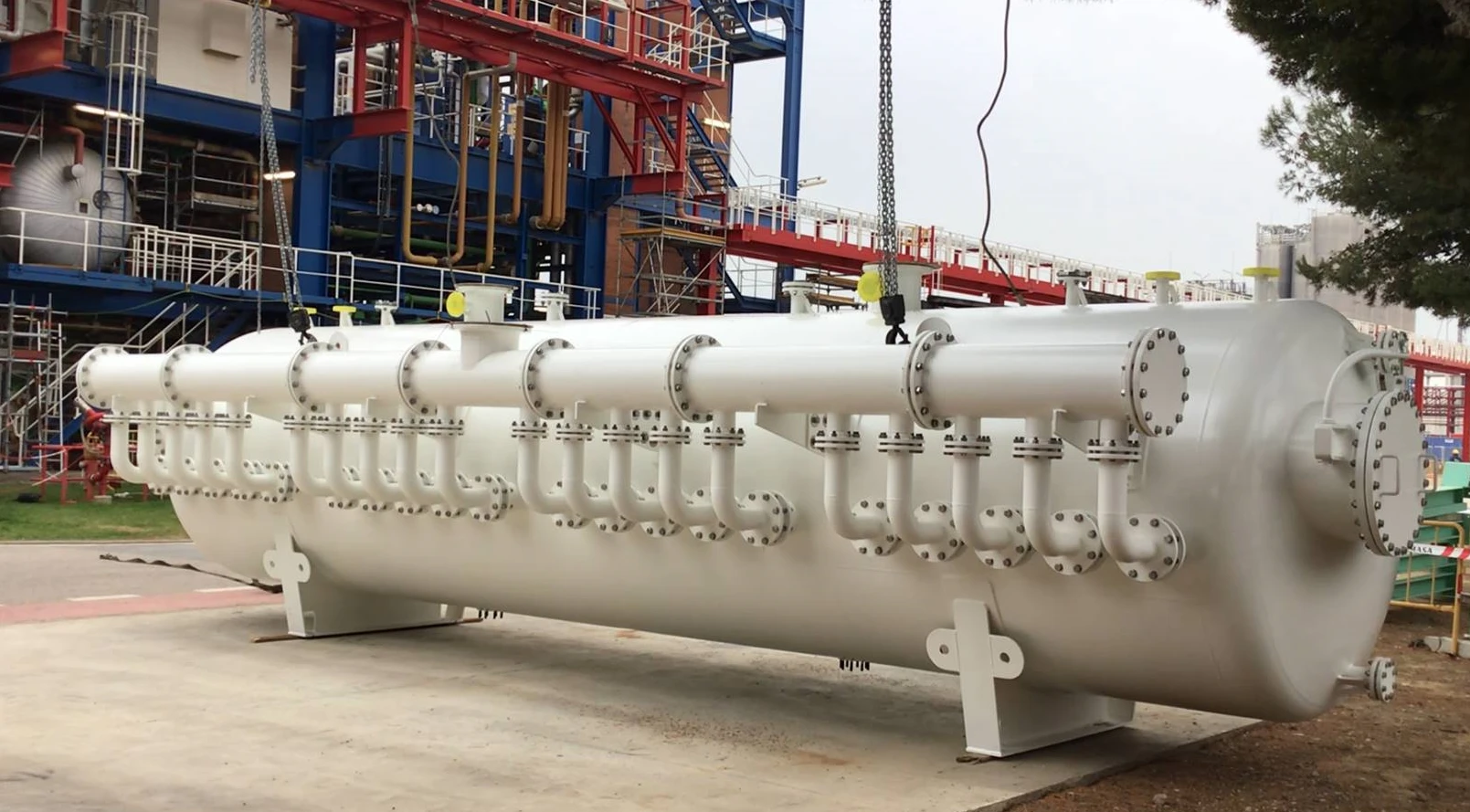
Hydraulic Flame Arrester of Series TS/… mainly consist of the immersion tank (1) with exhaust air nozzle and connection nozzles for the sparge pipes, the sparge pipes (2) with elbows and connection flanges as well as the manifolds (3) with connection flanges. To allow measurement of the immersion liquid temperature, the tank (1) has a minimum of one nozzle (5) and, for measuring the temperature of the exhaust gas, there is a minimum of one connection for each exhaust air nozzle (6) for inserting temperature sensors. Additionally, the tank has two nozzles (7, 8) for level measurement, two nozzles (9, 10) for level control, and one nozzle (11) for draining. Inspection glasses (4) are included for inspection of the immersion liquid and gas space.
Removing the Sparge Pipes Makes Cleaning Easier
The sparge pipes can be pulled out of the Hydraulic Flame Arrester to allow cleaning of the drill holes and pipes. They contain the appropriate flange connections for the supply of exhaust air and, depending on the distribution of the exhaust air flow, the number of nozzles for distribution to the sparge pipes.
Flame Backfire Is Prevented
In PROTEGO® Type TS/… Hydraulic Flame Arresters. The flammable mixtures are passed through a water
seal
Seal
A seal prevents or limits unwanted transfer of product from one container to another. Seal is used as superordinate term for all types of sealing elements.
with a defined immersion depth. The mixture flow is divided and supplied evenly to the individual sparge pipes. The sparge pipes have small drill holes, which produce defined bubble columns. In case of an ignition in the flowing gas mixture, the flame is prevented from returning into the inlet line. The following parameters have a significant effect on the flame arresting efficiency of the
device
Device
A device is a pipe component that influences the media flow by opening, closing, or partially shutting off the flow channel or by dividing or mixing the media flow.
in case of deflagrations, detonations, or short-time burning:
• Mixture volume flow
• Immersion depth from the water seal‘s surface to the upper edges of the drill holes in the sparge pipes,
• Water temperature in the
hydraulic flame arrester
Hydraulic flame arrester
Flame arrester designed to break the flow of an explosive mixture into discrete bubbles in a water column, thus preventing flame transmission.
• Precise drill hole diameter in the sparge pipes due to size, form, and density of the bubbles.
Ensures Limited Ignition Transmission Safety
If the mixture ignites under certain operating conditions within the Hydraulic Flame Arrester and burns directly on the liquid surface, prevention of flame transmission can only be guaranteed for a limited amount of time. So, several temperature sensors are installed in the gas space, and, when reaching a specified temperature, they trigger appropriate emergency functions upstream in the connected system (shut down,
inerting
Inerting
Replacing atmospheric oxygen in a plant with a non-reactive, non-flammable gas to prevent flame propagation in the atmosphere of a plant.
, etc.).
Requirements for Hydraulic Flame Arrester
A high accuracy volume flow meter must be installed as an essential technical safety element. It has to guarantee that the maximum allowable volume flow, on which the design of the Hydraulic Flame Arrester has been based, is recorded and limited so that emergency functions are triggered if the exhaust air volumes exceed the safe level. In addition, a minimum
flame transmission-proof
Flame transmission-proof
Characteristic of a device to avoid flashback.
immersion height is necessary, i.e. an adequate water level must be guaranteed by suitable measuring
equipment
Equipment
Machines, appliances, fixed or mobile devices, control parts and accessories, and warning and prevention systems, whether separate or combined, intended for the generation, transfer, storage, measurement, control, and conversion of energy, and for the processing of materials, which have their own potential source of ignition and may cause an explosion.
.
The pressure loss of a hydraulic flame arrester at maximum volume flow results from the inlet and outlet losses of approximately 12 to 18 mbar / 4.8 to 7.2 inch W.C. plus the immersion depth, e.g. 350 mm = 35 mbar / 13.8 In = 14.1 inch W.C., so the total is between 47 and 53 mbar / 18.9 and 21.3 inch W.C.
Si tienes alguna pregunta, comentario o sugerencia, nuestro equipo de expertos estará encantado de ayudarte.