VD/TS
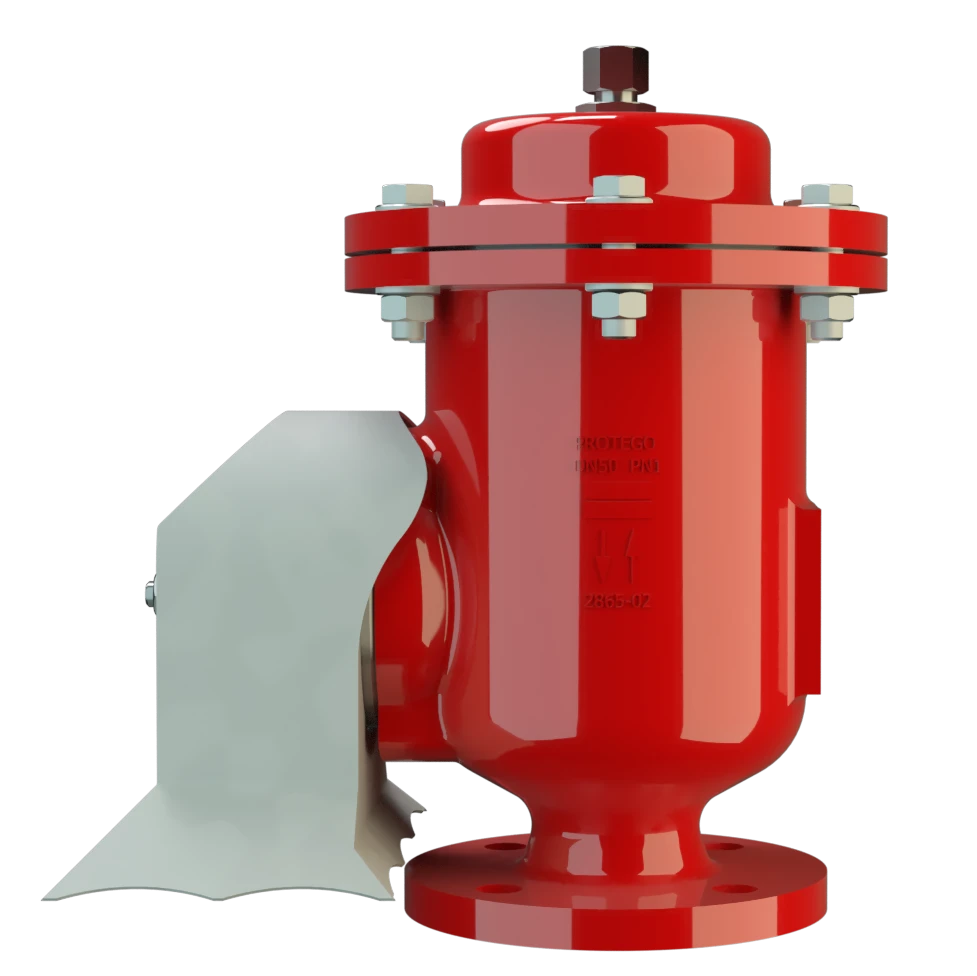
Válvula de emergencia de presión/vacío con apagallamas incorporado a prueba de deflagraciones atmosféricas
Features
10% Technology
Extreme Tightness
Optimum Pressure Maintenance
Guided Valve Pallet
Protective System According to ATEX
Intergrated Flame Arrester
Flow Capacity
Sturdy Housing Design
API Tanks
Válvula combinada de alivio de presión y vacío

Tecnología del 10%
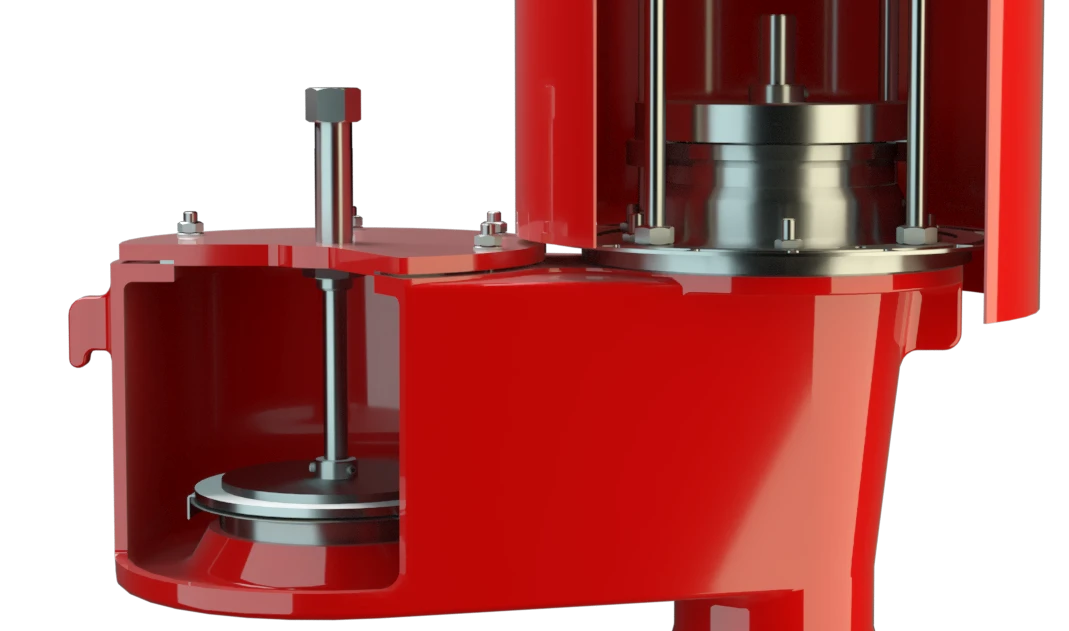
Materiales personalizados

Componente Principal: Apagallamas PROTEGO®
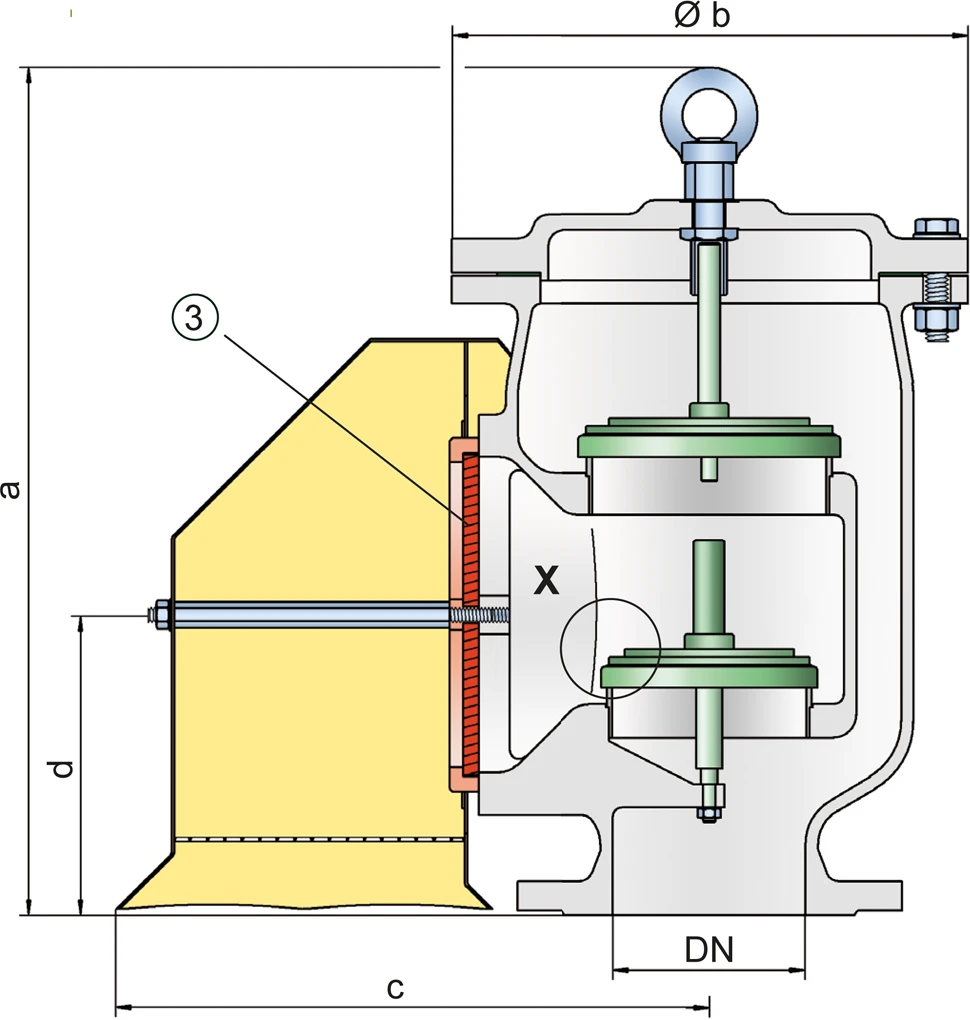
Dimensiones
Para seleccionar el tamaño nominal (DN), utilícense los diagramas de flujo volumétrico abajo indicados
| DN | 50 / 2" | 80 / 3" | 100 / 4" | 125 / 5" | 150 / 6" | 200 / 8" | 250 / 10" | 300 / 12" |
| a | 340 / 13.39 | 430 / 16.93 | 490 / 19.29 | 610 / 24.02 | 610 / 24.02 | 705 / 27.76 | 765 / 30.12 | 930 / 36.61 |
| b | 210 / 8.27 | 280 / 11.02 | 310 / 12.20 | 390 / 15.35 | 390 / 15.35 | 445 / 17.52 | 505 / 19.88 | 560 / 22.05 |
| c | 206 / 8.11 | 277 / 10.91 | 347 / 13.66 | 427 / 16.81 | 427 / 16.81 | 534 / 21.02 | 604 / 23.78 | 823 / 32.40 |
| d | 125 / 4.92 | 150 / 5.91 | 180 / 7.09 | 230 / 9.06 | 230 / 9.06 | 270 / 10.63 | 310 / 12.20 | 445 / 17.52 |
Dimensiones en mm / pulgadas
Selección del grupo de explosión
| MESG | Gr. Expl. (IEC / CEN) | Grupo de Gas (NEC) |
| ≥ 0,65 mm | IIB3 | C |
Homologaciones especiales bajo demanda
Especificación de la máx. temperatura de operación
| ≤ 60°C / 140°F | Tmáx - Temperatura máxima de operación admisible en °C |
| - | Designation |
Temperaturas de operación más altas bajo demanda
Selección de materiales para la vivienda
| Diseño | A | C | D | E | ||
| Cuerpo | Aluminio | Acero | Acero inox | Hastelloy | ||
| Asientos de válvula | Acero inox | Acero inox | Acero inox | Hastelloy | ||
| Junta | PTFE | PTFE | PTFE | PTFE | ||
| Capucha de protección |
|
| Acero inox | Hastelloy | ||
| Unidad apagallamas | A | A | A | C | ||
| Plato de válvula de presión | A-F | A-F | A-F | G-I | ||
| Plato de válvula de vacío | A-E | A-E | A-E | F-H |
Materiales especiales bajo petición
Combinación de materiales para la unidad apagallamas
| Diseño | A | C |
| FLAMEFILTER® jaula | Acero inox | Hastelloy |
| FLAMEFILTER® | Acero inox | Hastelloy |
Materiales especiales bajo petición
Selección de materiales para la válvula de presión
| Diseño | A | B | C | D | E | F | G | H | I |
| Rango de presión [mbar] [inch W.C.] | +3.5 up to +5,0 +1.4 up to +2.0 | >+5.0 up to +14 >+2.0 up to +5.6 | >+14 up to +35 >+5.6up to +14 | >+35 up to +50 >+14 up to +20 | >+14 up to +35 >+5.6up to+14 | >+35 up to +50 >+14 up to +20 | +3.5 up to +5,0 +1.4 up to +2.0 | >+5.0 up to +14 >+2.0 up to +5.6 | >+14 up to +35 >+5.6 up to +14 |
| Plato de válvula | Aluminio | Acero inox | Acero inox | Acero inox | Acero inox | Acero inox | Titanio | Hastelloy | Hastelloy |
| Sello Sello A seal prevents or limits unwanted transfer of product from one container to another. Seal is used as superordinate term for all types of sealing elements. | FEP | FEP | Metal a Metal | Metal a Metal | PTFE | PTFE | FEP | FEP | Metal a Metal |
| Peso | Acero inox | Acero inox | Acero inox | Plomo | Acero inox | Plomo | Hastelloy | Hastelloy | Hastelloy |
Special material as well as higher set pressure Presión de reacción Set pressure is the gauge pressure at the device inlet at which the relief device is set to start opening under service conditions. upon request
Selección de materiales para la válvula de vacío
| Diseño | A | B | C | E | F | G | H |
| Rango de vacío [mbar] [inch W.C.] | -2.0 up to -3.5 -0.8 up to -1.4 | <-3.5 up to -14 <-1.4 up to -5.6 | <-14 up to -25 <-5.6 up to -10 | <-14 up to -25 <-5.6 up to -10 | -2.0 up to -3.5 -0.8 up to -1.4 | <-3.5 up to -14 <-1.4 up to -5.6 | <-14 up to -25 <-5.6 up to -10 |
| Plato de válvula | Aluminio | Acero inox | Acero inox | Acero inox | Titanio | Hastelloy | Hastelloy |
| Sello | FEP | FEP | Metal a Metal | PTFE | FEP | FEP | Metal a Metal |
| Peso | Acero inox | Acero inox | Acero inox | Acero inox | Hastelloy | Hastelloy | Hastelloy |
Materiales especiales y tarados de vacío más altos bajo demanda
Tipo de bridas de conexión
| EN 1092-1; Form B1 |
| ASME B16.5 CL 150 R.F. |
Otros tipos bajo petición
Diagrama de flujo volumétrico

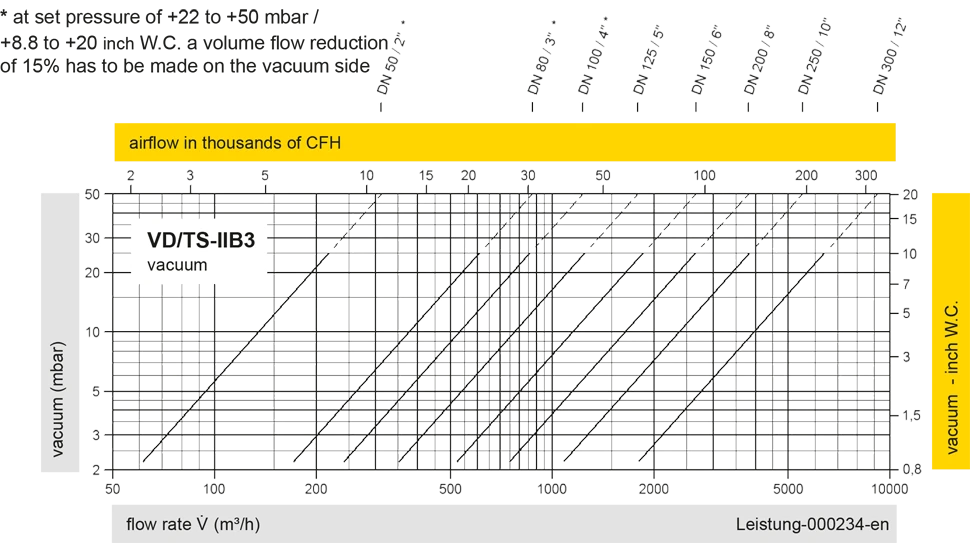
Los diagramas de flujo volumétrico han sido determinados con un banco de pruebas de caudal calibrado y certifi - cado por TÜV. El flujo volumétrico V. en [m³/h] y el CFH se refi eren a las condiciones estándar de referencia de aire según ISO 6358 (20°C, 1bar). La conversión a otras densidades y temperaturas están referidas en el Vol. 1: “Fundamentos Técnicos”.
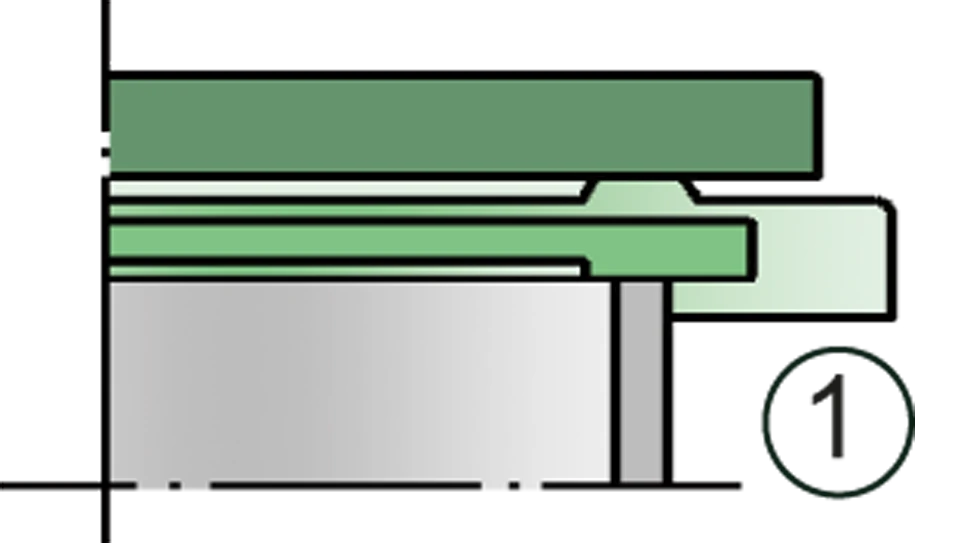
Detalle X
Detalle X
Si tienes alguna pregunta, comentario o sugerencia, nuestro equipo de expertos estará encantado de ayudarte.