


PV/EB-E
Pressure/Vacuum Relief Valve deflagration- and endurance burning-proof
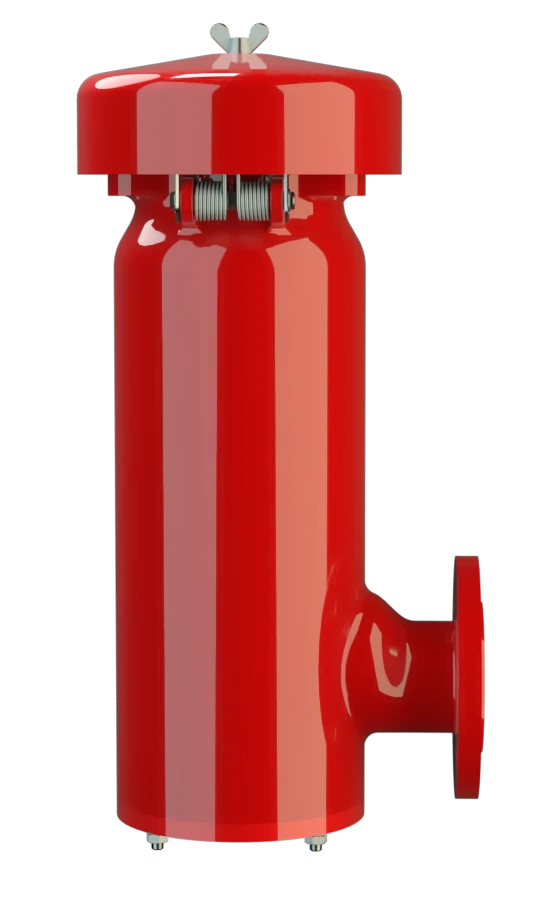
Features
Extreme Tightness
Optimal Pressure Maintenance
Guided Valve Pallet
Protective System According to ATEX
Protected for Alcohol/Air Mixtures
Safety Against Endurance Burning
Lifting Device
Modular Design
Intergrated Flame Arrester
Combined Pressure and Vacuum Relief Valve
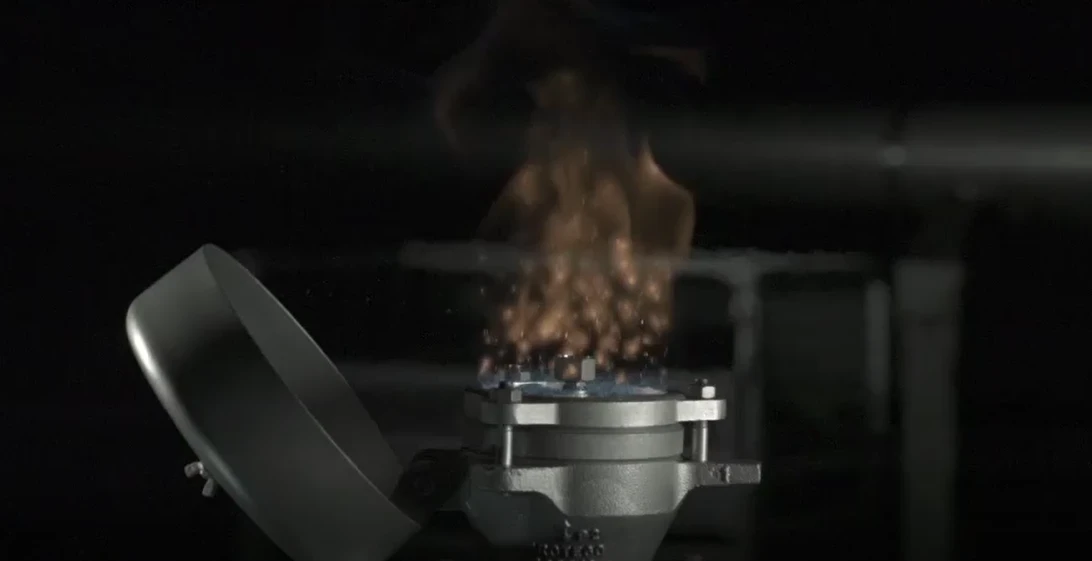
Deflagration and Endurance Burning Proof
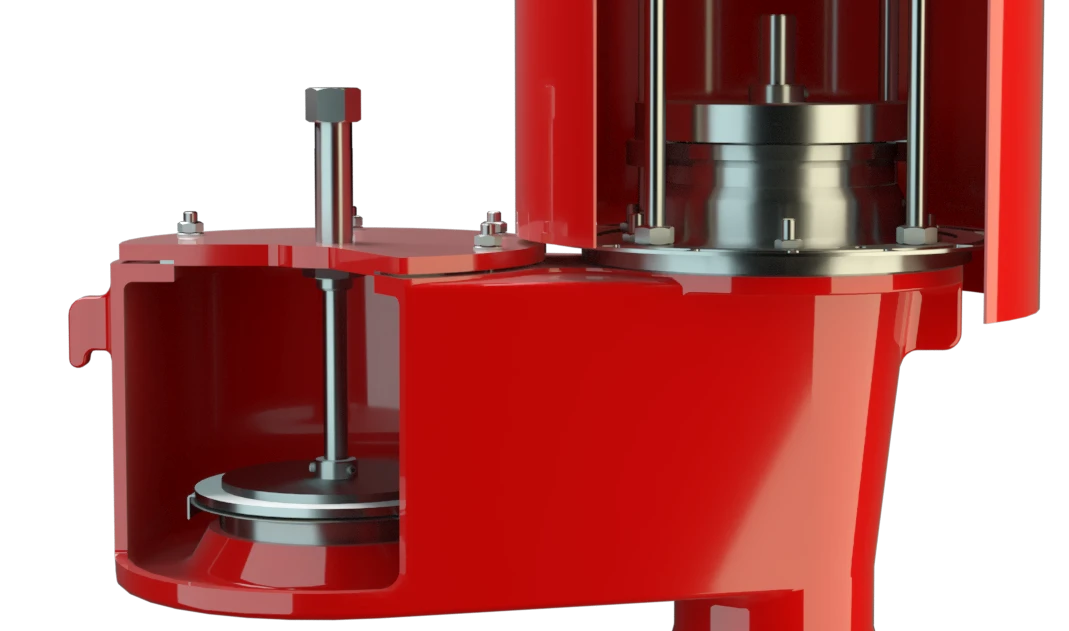
Custom Materials

Main Component – PROTEGO® Flame Arrester Unit

Many Individual Certifications
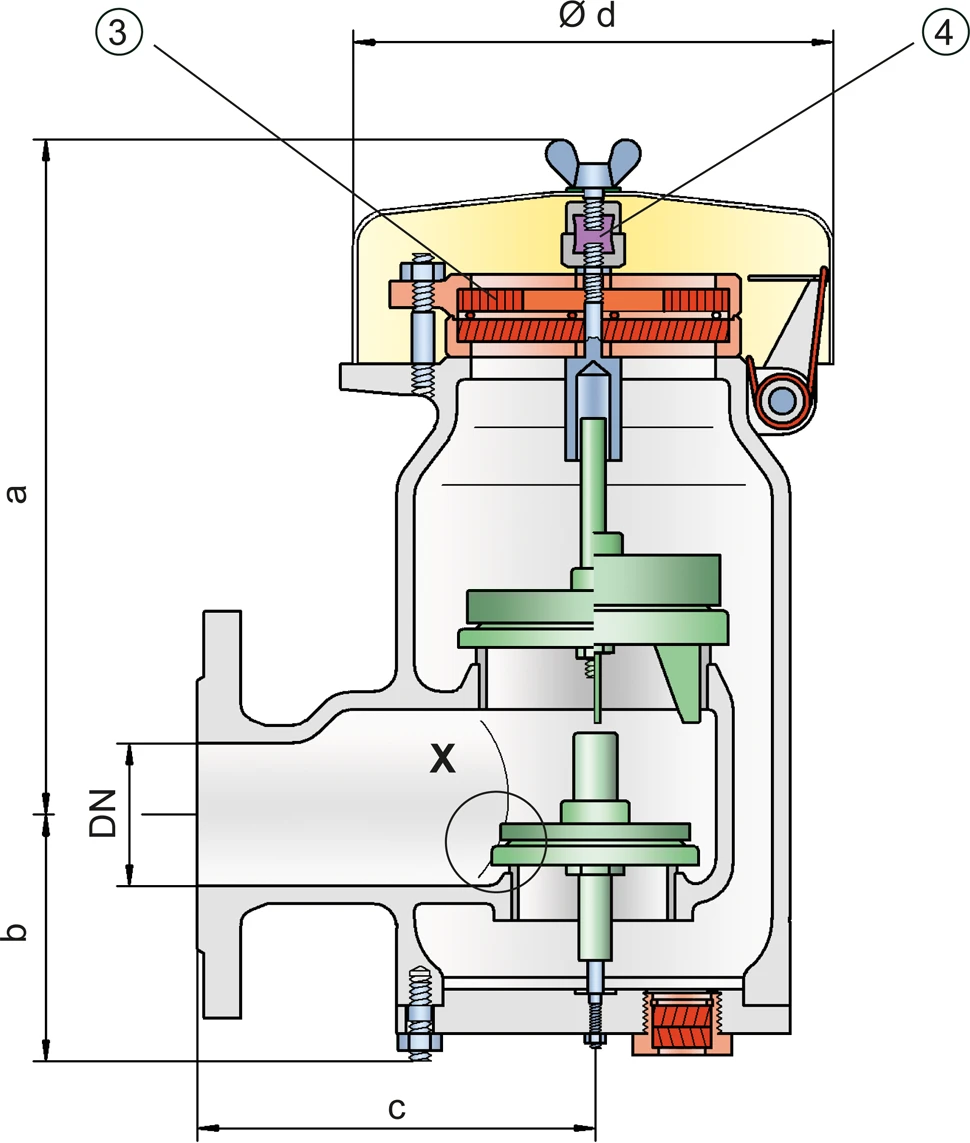
Dimensions
To select the nominal size Nominal size The nominal size is an alphanumeric designation of size for components in a piping system, used for reference purposes, comprising the letters DN followed by a dimensionless integer that is indirectly related to the physical size of the bore or outside diameter of the connections, expessed in millimeters. (DN), please use the flow capacity charts on the following pages
| DN | 50 / 2" | 50 / 2" | 80 / 3" | 80 / 3" | |
| DN | 2" | 2" | 3" | 3" | |
| Set pressure | ≤ +60 mbar | > +60 mbar | ≤ +60 mbar | > +60 mbar | |
| Set pressure | ≤ +24.1 inch W.C. | > +24.1 inch W.C. | ≤ +24.1 inch W.C. | > +24.1 inch W.C. | |
| a | 308 / 12.13 | 443 / 17.44 | 308 / 12.13 | 443 / 17.44 | |
| b | 108 / 4.25 | 108 / 4.25 | 108 / 4.25 | 108 / 4.25 | |
| c | 165 / 6.50 | 165 / 6.50 | 167 / 6.57 | 167 / 6.57 | |
| d | 218 / 8.58 | 218 / 8.58 | 218 / 8.58 | 218 / 8.58 |
Dimensions in mm / inches
Dimensions for pressure/ vacuum relief valve Vacuum relief valve A vacuum relief valve is used to ventilate a part of the system and protects it from impermissible underpressure. with heating jacket upon request
Selection of explosion group
| MESG | Expl. Gr. (IEC / CEN) | Gas Group (NEC) |
| ≥ 0,85 mm | IIB1 | – |
Special approvals upon request
Material selection for housing
| Design | B | C |
| Housing Housing A housing is a solid shell, which surrounds a content, either protecting the content from external influences, or protecting the environment from the content. | Steel | Stainless Steel |
| Heating jacket(PV / EB-E-H-...) | Steel | Stainless Steel |
| Valve seat Valve seat The valve seat is a component on which the valve pallet rests when the valve is closed. | Stainless Steel | Stainless Steel |
| Weather hood | Steel | Stainless Steel |
Special materials upon request
Material combinations of flame arrester unit
| Design | A |
| FLAMEFILTER® cage | Stainless Steel |
| FLAMEFILTER® | Stainless Steel |
| Spacer Spacer The spacer is a component that is generally used in a PROTEGO® flame arrester as a spacer within the FLAMEFILTER® set. | Stainless Steel |
Special materials upon request
Material selection for pressure valve pallet
| Design | A | B | C | D |
| Pressure range [mbar] [inch W.C.] | +2.0 up to +3.5 +0.8 up to +1.4 | >+3.5 up to +14 >+1.4 up to +5.6 | >+14 up to +210 >+5.6 up to +84 | >+35 up to +210 >+14 up to +84 |
| Valve pallet Valve pallet Valve pallet is the generic term for the assembly that rests on the valve seat. | Aluminium | Stainless Steel | Stainless Steel | Stainless Steel |
| Sealing | FEP | FEP | Metal to Metal | PTFE |
Special material as well as higher set pressure upon request
Material selection for vacuum valve pallet
| Design | A | B | C | D |
| Vacuum range [mbar] [inch W.C.] | -3.5 up to -5.0 -1.4 up to -2.0 | <-5.0 up to -14 <-2.0 up to -5.6 | <-14 up to -35 <-5.6 up to -14 | <-14 up to -35 <-5.6 up to -14 |
| Valve pallet | Aluminium | Stainless Steel | Stainless Steel | Stainless Steel |
| Sealing | FEP | FEP | Metal to Metal | PTFE |
Special material as well as higher set vacuum Set vacuum Internal negative gauge pressure at which a vacuum valve first opens. upon request
Flange connection type
| EN 1092-1; Form B1 |
| ASME B16.5 CL 150 R.F. |
other types upon request
Flow Capacity Chart
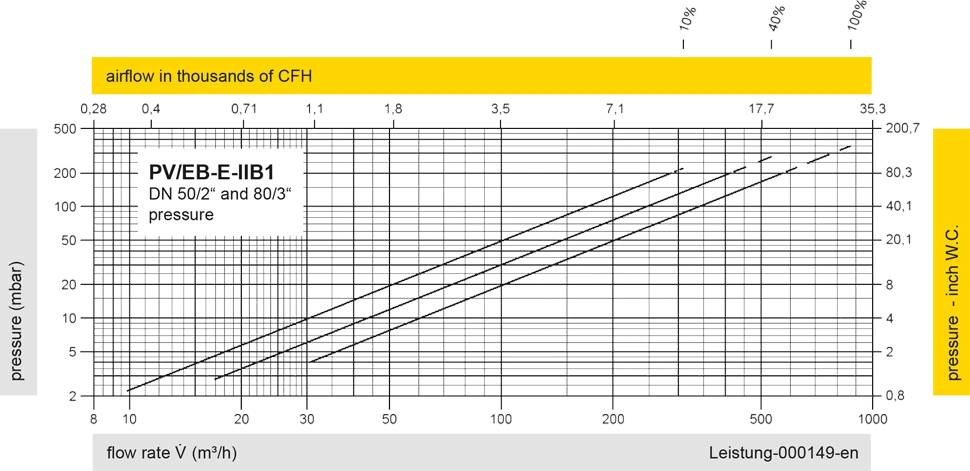
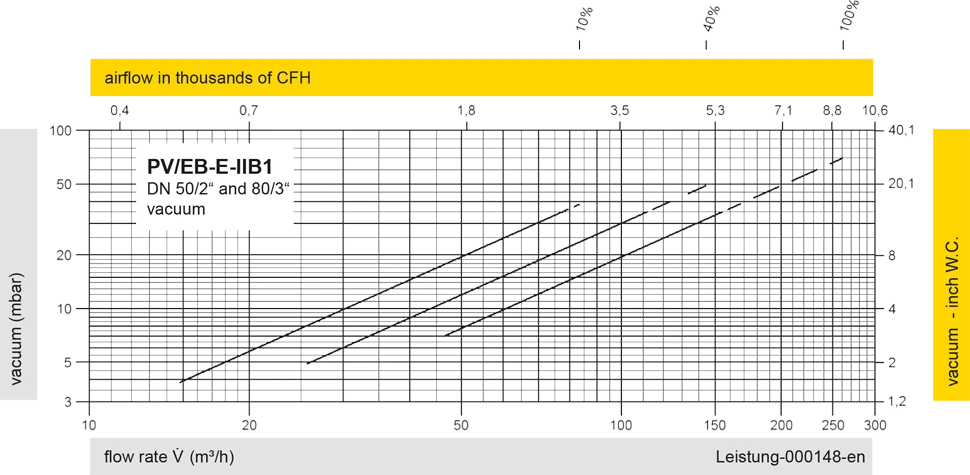
The flow capacity charts have been determined with a calibrated and TÜV certified flow capacity test rig. Volume flow V in (m³/h) and CFH refer to the standard reference conditions of air ISO 6358 (20°C, 1bar). For conversion to other densities and temperatures refer to Sec. 1: “Technical Fundamentals”.
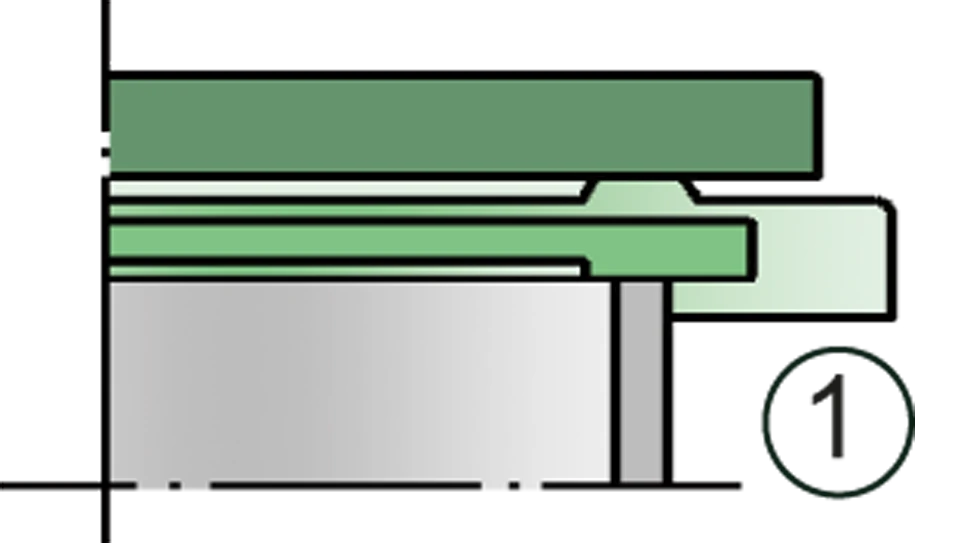
Detail X
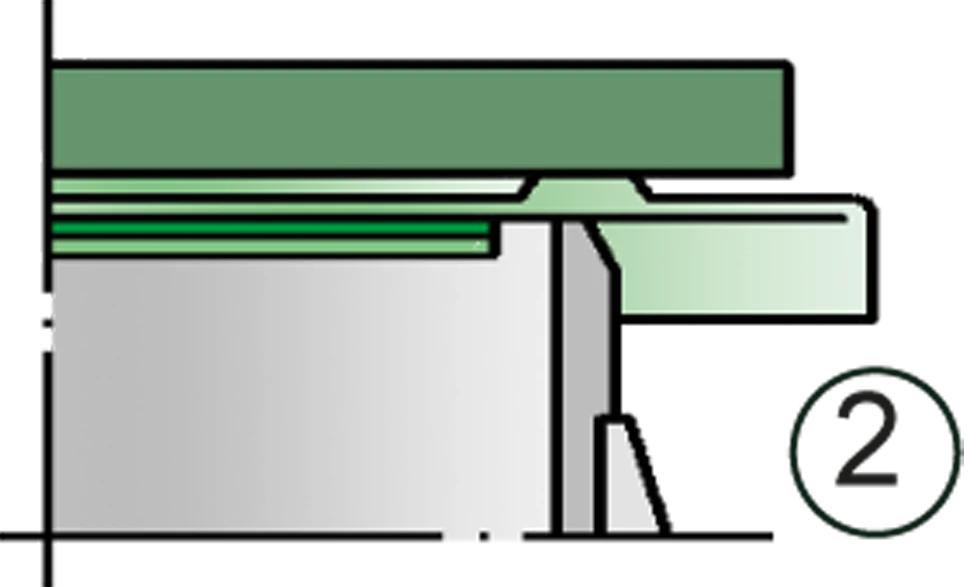
Detail X
 PROTEGO®
 Representative
 PARC / Service Partner