


BR/TS-80-IIB-P1,6
Detonation Flame Arrester for tank ships and containers
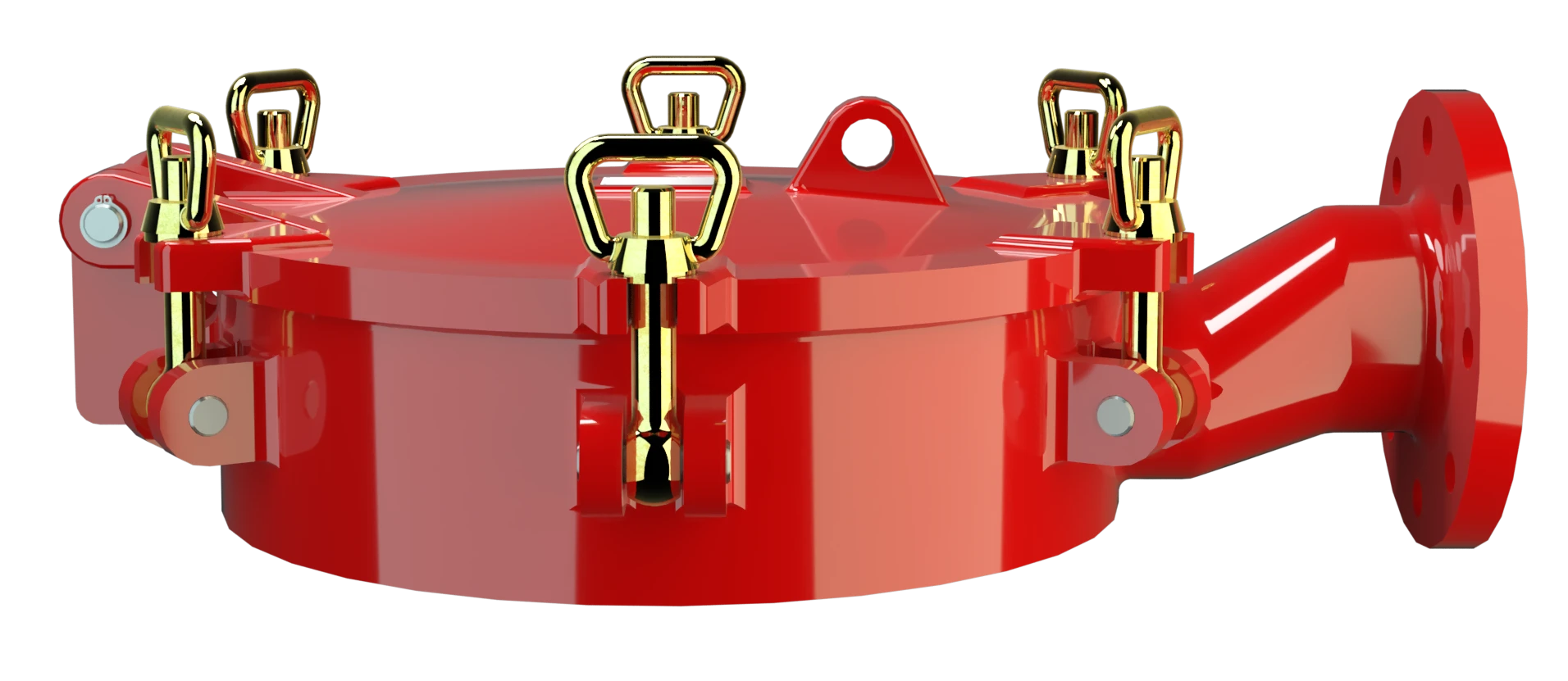
Features
Meets all ADNR* Requirements
* PRESCRIPTION OF THE TRANSPORT OF DANGEROUS GOODS ON THE RHINE
Flat Design
Emergency Venting
with the flexibly mounted Flame Arrester enables use even in Bad Weather Conditions as well as with Contaminated Products
Easy Maintenance
Extraordinarily Easy to Service
Modular Design
Allows Replacement and Cleaning of Single FLAMEFILTER®
Calculation of Loading and Unloading Rates
We offer Support in Calculating Loading and Unloading Rates
For Flammable Liquids
Useable for Nearly All Flammable Liquids
Maintenance and Cleaning Hatch
May be used as Maintenance and Cleaning Hatch
Spare Parts
Cost-Effective Spare Parts
Function and Description
Protection of Tanker Ships and Containers
The PROTEGO® BR/TS-80-IIB-P1.6 Detonation Flame Arrester was developed for protecting tankships but can also be used for containers. These devices are especially used on tank ships operating on inland waterways or coastal shipping. The
device
Appareil
A device is a pipe component that influences the media flow by opening, closing, or partially shutting off the flow channel or by dividing or mixing the media flow.
is installed on the tank or a pipe section connected to the tank with a
nominal size
Diamètre nominal
The nominal size is an alphanumeric designation of size for components in a piping system, used for reference purposes, comprising the letters DN followed by a dimensionless integer that is indirectly related to the physical size of the bore or outside diameter of the connections, expessed in millimeters.
of 250 mm / 10" and connected to the vapour balancing line (DN 80 / 3"). The individual tanks connected via the vapour balancing line are technically decoupled by the
detonation arresters
Arrête-flammes antidétonation
Flame arrester designed to prevent the transmission of a detonation.
and protected.

Main Component – PROTEGO® Flame Arrester Unit
The device protects against unidirectional detonation. In particular, the arrester consists of a
shock absorber
Amortisseur de choc
A shock absorber is a device that reduces the kinetic energy of a detonation.
(1) and the PROTEGO® Flame Arrester Unit (2). The PROTEGO® Flame Arrester Unit consists of several FLAMEFILTER® discs (3) and spacers firmly held in a
FLAMEFILTER® cage
Cage d'éléments arrête-flammes
The FLAMEFILTER® cage is a housing for a FLAMEFILTER® set.
(4). It is moveable and can be folded to the side for maintenance. The primary goal of this design is to enable the tank to be vented or supplied with air in an emergency when ice or crystallizing products clog the FLAMEFILTER®.

For Explosion Groups IIA to IIB
The PROTEGO® BR/TS Flame Arrester is available for explosion groups IIA to IIB (NEC group D to B MESG ≥ 0.5 mm).
The standard design is approved up to an
operating temperature
Operating temperature
Temperature reached when the equipment is operating under design conditions.
of +60°C / 140°F and an
operating pressure
Pression de service
Operating pressure is the pressure existing at normal operating conditions within the system being protected.
up to 1.6 bar / 23.2 psi (absolute), and it meets all the conditions of the ADN* for hazardous goods transport on European Inland Waterways.
EU conformity according to the currently valid ATEX directive. Approvals according to other national/international regulations on request.
Product Data
Material selection for housing
| Design | A | B | |
| Housing | Steel | Stainless Steel | |
| Cover | Steel | Stainless Steel | |
| Gasket | Tankatite | Tankatite | |
| Flame arrester unit Flame arrester unit Flame arrester casing with FLAMEFILTER® set. | A | A |
Material selection for flame arrester unit
| Design | A |
| FLAMEFILTER® cage | Stainless Steel |
| FLAMEFILTER® | Stainless Steel |
| Spacer | Stainless Steel |
Flange connection type
| EN 1092-1; Form B1 |
| ASME B16.5 CL 150 R.F. |
Flow Capacity Chart
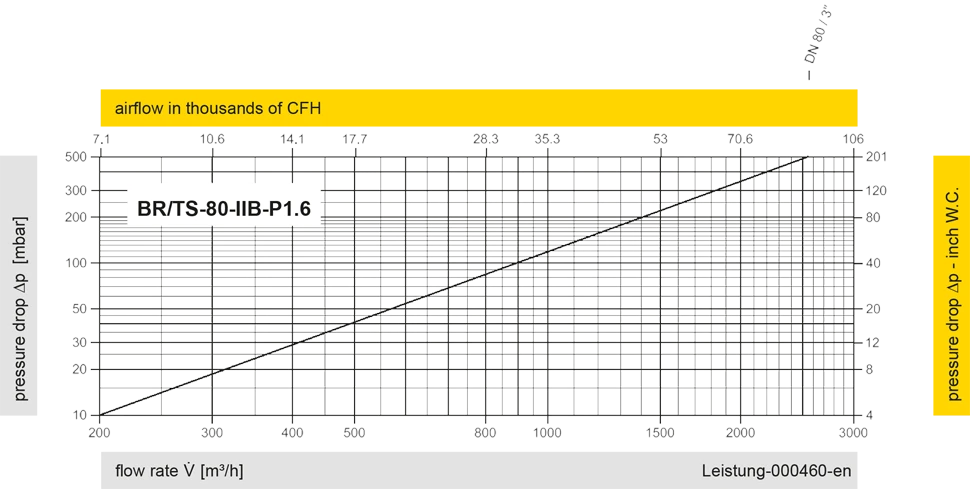
The flow capacity charts have been determined with a calibrated and TÜV certified flow capacity test rig. Volume flow V in (m³/h) and CFH refer to the standard reference conditions of air ISO 6358 (20°C, 1bar). For conversion to other densities and temperatures refer to Sec. 1: “Technical Fundamentals”.

Finding your location…
 PROTEGO®
 Representative
 PARC / Service Partner
No results found