


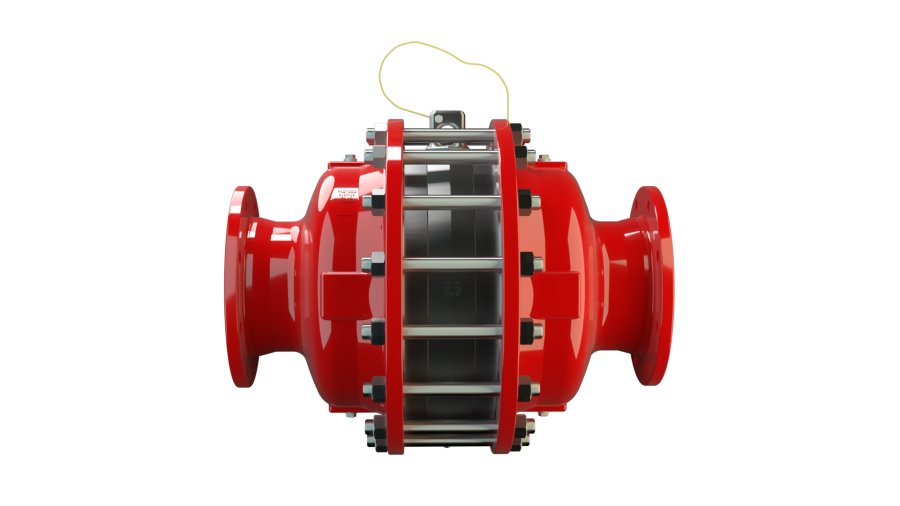
A flame arrester, deflagration arrester, or flame trap is a device or form of construction that will allow free passage of a gas or gaseous mixture but will interrupt or prevent the passage of flame.
Flame arresters are safety devices fitted to openings of enclosures or to pipe work, and are intended to allow flow but prevent flame transmission. A flame arrester Flame arrester Device fitted to the opening of an enclosure, or to the connecting pipe work of a system of enclosures, and whose intended function is to allow flow but prevent the transmission of a flame. functions by absorbing the heat from a flame front thus dropping the burning gas/air mixture below its auto- ignition temperature Ignition temperature Lowest temperature (of a hot surface) at which ignition of a flammable gas or vapor in a mixture with air or air/inert gas occurs under specified test conditions. ; consequently, the flame cannot survive.
The heat is absorbed through channels (passages) designed into an element. These channels are chosen and measured as the MESG (maximum experimental safe gap) of the gas for a particular installation. These passages can be regular, like crimped metal ribbon or wire mesh or a sheet metal plate with punched holes, or irregular, such as those in random packing.
The required size of the channels needed to stop the flame front can vary significantly, depending on the flammability of the fuel mixture. The large openings on a chain link fence are capable of slowing the spread of a small, slow-burning grass fire, but fast-burning grass fires will penetrate the fence unless the holes are very small.[4] In a coal mine containing highly explosive coal dust or methane, the wire mesh of a Davy lamp must be very tightly spaced.